
Is It Necessary To Dry Processed Instruments Prior To Sterilization?
Novo Surgical has just returned from IAHCSMM’s 2019 Annual Conference in Anaheim, California. The meeting was attended by over 1,300 CS and SPD professionals from healthcare facilities from around the country. During the four day event (April 27-30), attendees were able to attend keynote speaker presentations and participate in a wide range of labs and workshops. Additionally, they were able to see and interact with over 200 product and value-added service exhibitors.
For those not familiar with IAHCSMM, the IAHCSMM Annual Conference “Provides attendees with resources needed to elevate their knowledge and promote ongoing quality and professionalism within their department. From knowledge-building hands-on labs and workshops to timely management and technical updates taught by some of the professions most renowned and respected experts, plus poster sessions, discussion groups, and the largest vendor exposition for the CS profession.”1
During one of the many concurrent sessions (“Infection Prevention 101”) there were some lively exchanges among the participants about the need for instruments to be dry prior to sterilization. Some members in the session group felt that they don't need to be dry because they would get wet in the sterilizer. Others felt very strongly that they should be completely dry prior to sterilization. It was clear from the audience that this topic is hotly debated at many hospitals and healthcare facilities.
Based on many comments from the attendees, it would appear that the misconception for not drying instruments comes from the belief that there's no point in doing so because “The instruments will get wet anyway when exposed to steam.” 2 The problem with this view is that this introduces more moisture into the sterilization cycle.
Most, if not all, commercial sterilizers are not able to remove all of this excess moisture. Moisture can inhibit the process of steam sterilization. Even worse, it can cause major problems if you are using EtO to sterilize your instruments. According to module III of the AAMI book on sterile processing: "In cases like ethylene oxide (EtO) sterilization, moisture combines with the sterilant to create a toxic byproduct that can remain on the instruments and cause harm to the patients. Moist items in a hydrogen peroxide plasma sterilizer will cause the sterilization cycle to fail." 3
Excess moisture can result in wet packs that in turn compromise the entire sterilization process. This is because instruments use a lot of steam to heat-up during the start of the sterilization cycle. However, the amount of energy needed to vaporize water is dramatically more than the energy needed to initially heat the instruments. Accordingly, you are asking a lot of the sterilizer to make it boil-off water in hard-to-reach locations (i.e., lumens, box-locks, etc.), creating ‘cold spots’ that may not get sterilized. 4
The goal of every sterilization cycle to have all packs and trays emerge from the sterilizer dry and moisture-free. Given that no one wants wet loads after sterilization, why would you start the process by putting wet instruments into your sterilizer? Your sterilizer has enough work to do to heat up heavy loads at the start of the sterilization cycle. Boiling-off excess moisture creates an additional challenge that your sterilizer doesn’t need.
If packs and trays are wet when they come out of the sterilizer, the paper on the pouch can transmit bacteria from a person’s hands onto the instruments. Wet packs and instruments are an excellent nidus for water-borne bacteria that can cause a surgical infection. Additionally, instruments, even ‘stainless’ steel instruments, that are repeatedly exposed to moisture can, over time, rust and degrade.
The first step to eliminate the problem of wet loads is to always follow both the instrument and the sterilizer manufacturers' IFUs. All of the instrument manufacturers’ IFU that we’ve reviewed in preparing this blog say to dry the instruments before wrapping and placing them into the sterilizer. Numerous studies have shown decreased sterilization efficacy if the instruments are wet, especially in lumens. Instruments simply must be dry prior to sterilization to ensure 100% bacteria kill. 5
All sterilizers, regardless of the manufacturer, have differing abilities to remove excess moisture from the incoming steam. According to ANSI/AAMI ST79, all steam supplies are required to provide steam that contains no more than 3% liquid water. Any extra moisture introduced into the sterilizer will simply not be pulled out. The type of items, the materials they are made from, the type/brand of wrap, the wicking material, the dryness of the instruments and the load configuration all have an impact on the end result. 6
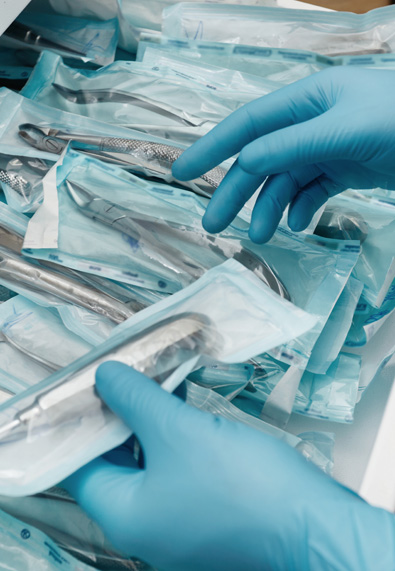
The need to dry your instruments prior to wrapping and loading them into your sterilizer can not be over emphasized. If you load wet instruments into your sterilizer, you will have wet packs at the end of the sterilization cycle. The problems created by wet packs and instruments (surgical infections, rust, contaminated wraps, etc.) can all be eliminated by thoroughly drying your instruments prior to sterilization and following the manufacturers’ IFUs.
- https://www.iahcsmm.org/events/annual-conference-expo.html
- Comment from an IAHCSMM member during the “Infection Prevention 101” session Sunday, April 28, 2019.
- AAMI publication “Sterile Processing in Healthcare Facilities Preparing for Accreditation Surveys, 3rd Edition”2017
- AAMI publication “ANSI/AAMI ST79” 2017
- Cite.
- Cite.
May 3, 2019
8 view(s) 