
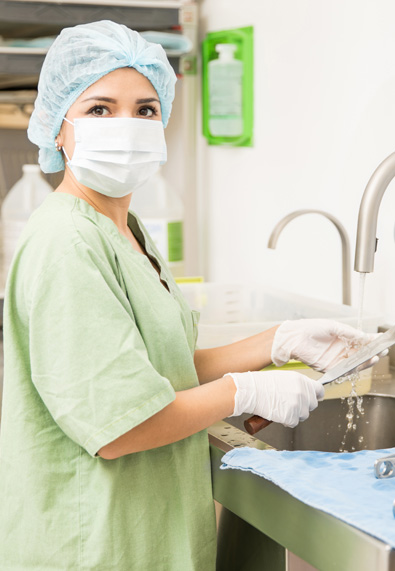
Water’s Role in Instrument Reprocessing
The reprocessing of surgical instruments is defined as the process of removing foreign material (e.g., bioburden, biofilm) from the instruments and is usually accomplished using water with detergents or enzymatic products that are suitable for use. Surgical instruments must be thoroughly cleaned before high-level disinfection and sterilization because inorganic and organic materials that remain on the surfaces of instruments interfere with the effectiveness of these processes (“if it’s not clean, it can’t be safe!”).
The proper cleaning of surgical instruments starts in the O.R. by placing the contaminated instruments into sterile water or an approved enzymatic detergent. This first step in the cleaning process is vital because if soiled organic materials are allowed to dry or become baked onto the instruments, the removal process becomes much more difficult. Even worse, it can render the disinfection or sterilization process less effective, or even ineffective. This is why it is so important that surgical instruments be presoaked or rinsed in neutral pH (7 or lower) water immediately after use and prior to transport to prevent blood from drying and to soften or remove blood from the instruments.1
The thorough and complete cleaning of surgical instruments has a critical impact on the performance and safety of those instruments. The old saying “If it isn’t clean, it can’t be sterile” is as true today as it was 50 years ago. Regardless of how thoroughly CS/SPD personnel sterilize an instrument, it will not be safe to use on a patient if the cleaning was inadequate.
Why is the first step in instrument reprocessing the immersion of the instrument into water? Water is called the universal solvent because more substances dissolve in water than in any other chemical. This has to do with the polarity of each water molecule. The hydrogen side of each water (H2O) molecule carries a slight positive electric charge, while the oxygen side carries a slight negative electric charge. This helps water dissociate ionic compounds into their positive and negative ions. The positive part of an ionic compound is attracted to the oxygen side of water while the negative portion of the compound is attracted to the hydrogen side of the water. 2
Annex P of ANSI/AAMI ST79 states that the proper decontamination and cleaning of reusable medical devices requires a number of steps. Each of these steps relies on numerous elements in order for the process to be successful. These elements can and do have an impact on cleaning. These important elements include:
- The quality of the water
- The concentration and type of detergent or enzymatic cleaner
- The use of an acceptable washing method
- The proper rinsing and drying
- The proper preparation of items to be processed by cleaning equipment
- The correct time and temperature parameters
- Not exceeding the load capacity of the equipment
- The performance of the operator and of the equipment
- The multiple factors that cause cleaning variability
- Assessment of water quality.
- Implementation of water treatment processes.
- Assurance of proper water quality for the various stages in medical device reprocessing.
- Ongoing monitoring of water quality.
- Rutala WA, Shafer KM. General information on cleaning, disinfection, and sterilization. In: Pfeiffer JA, ed. APIC infection control and applied epidemiology: principles and practice,. St. Louis: Mosby, 1996:15.1-15.17
- https://www.thoughtco.com/why-is-water-the-universal-solvent-609417
- https://my.aami.org/aamiresources/previewfiles/TIR34_1409_preview.pdf
May 10, 2019
7 view(s) 