
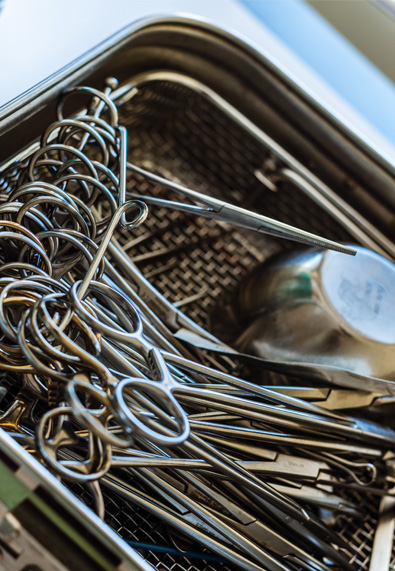
Hospital Forced To Cancel Surgeries Due To Discolored Instruments
A hospital had to cancel surgeries this month due to discolored surgical instruments. Earlier this year a hospital in Colorado had to cancel surgeries for an entire week due to contaminated instruments (see our blog post on that here).
During the week of November 5th, Tampa General Hospital in Tampa, Florida had to cancel over two dozen elective surgeries due to discolored surgical instruments. Hospital spokesman John Dunn said that "The issue surfaced during a routine quality check of surgical instruments performed prior to all surgeries. The hospital conducted lab testing on the instruments and found all were sterile and had no findings of any infectious agents."1
A week after cancelling over two dozen elective surgeries, Tampa General Hospital announced that they had discovered the cause of the instrument discoloration. The hospital attributes the problem to their sterilizer steam being contaminated by too many minerals in the water. They also cited reprocessing personnel as being being too aggressive in the use of cleaning chemicals on the surgical instruments.2
While the problem was determined to be unrelated to bio-burden contamination, it still highlights the importance of following manufacturer recommended instructions for use from device, sterilizer and cleaning agent manufacturers, as well as guidelines from national standards organizations like AAMI. These guidelines contain critical and often overlooked information including water quality and steam standards. Repeated exposure outside of those parameters can lead to discoloration and down time while the problem is being diagnosed. There are a lot of hidden factors that can contribute to issues, including buildup on piping or a lack of purified water in various steps of the cleaning process.
In previous blogs we’ve discussed the importance of having clean (i.e., free of any and all contaminates, including bioburden and biofilm), sterile, moisture-free instruments for every patient, every time. Achieving this goal is crucial when trying to minimize patient risk and patient harm caused by contaminated instruments and reusable medical devices.
CS/SPD reprocessing personnel have always been told that “If it’s not clean, it can’t be sterile” The more accurate statement is that “If it’s not clean, it can’t be safe!” Just because you sterilize a reusable medical device does not mean that it is safe to use, especially if it is still contaminated with debris, even microscopic debris, after sterilization.
In this case, the problem was identified visually but it's important to know that the human eye can't detect microscopic bio-burden, so visual inspection is not a fool proof method for examining reusable devices. This is where following validated cleaning instructions that have been verified to be efficacious in a laboratory are critical.
Thankfully, there were no surgeries conducted using the surgical instruments at Tampa General Hospital. The hospital was able to borrow surgical instruments from other hospitals in the area to meet the rest of their surgery schedule during the week.
"We regret the disruption this situation has caused our patients and surgeons," Dunn said. "However, ensuring patient safety continues to be our top priority."3
To solve these problems, the hospital installed micro-filters on their water supply to eliminate the minerals in the steam. Additionally, they are changing their cleaning process and products. According to Dunn, hospital test results show that the changes have resolved the issue.4
“Meanwhile, a spokeswoman for The Agency for Health Care Administration in Florida said the agency is reviewing the discolored instruments problem at Tampa General Hospital. A complaint with the Joint Commission was also filed.”5
Dr. Randy Shuck, a family medicine doctor who ran the residency program at St. Petersburg General Hospital, said he would not perform a surgery with discolored instruments. “In the end, if I were doing the surgery it needs to be pristine. There has to be no doubt in my mind. There has to be no question,” Shuck said. “The patient should have no question. The staff should have no question. So, that we walk in and it’s perfect, because it has to be, we don’t get a second chance.”6
Protecting patients from contaminated surgical instruments is the number one goal and mission of every CS/SPD department. As the September 2015 CDC Advisory stressed, non-compliance with the manufacturer’s recommended reprocessing procedures represents a critical gap in patient safety.7
Protecting your patients from harm caused by a contaminated instrument starts by following manufacturers’ published cleaning and reprocessing IFUs. Even more important than following the manufacturers’ published IFUs is to demand IFUs that have been validated by independent laboratory testing using AAMI and FDA test protocols. By only using instruments with validated IFUs you can have the documented assurance of providing clean, sterile, moisture-free instruments for every patient, every time!
The problem of contaminated instruments in the O.R. was addressed by the CDC in their September 11, 2015 Health Alert Advisory that stated:
“The Centers for Disease Control and Prevention (CDC) and U.S. Food and Drug Administration (FDA) are alerting healthcare providers and facilities about the public health need to properly maintain, clean, and disinfect or sterilize reusable medical devices. Recent infection control lapses due to non-compliance with recommended reprocessing procedures highlight a critical gap in patient safety.”8
Regretfully, even after this major Health Alert Advisory from the CDC, we have continued to see reports of devices causing canceled surgeries, patient harm and even patient deaths. This most recent example occurred just this month.
1.. Spectrum Bay News 9, Tampa, FL. November 7, 2018
2. Spectrum Bay News 9, Tampa, FL. November 13, 2018
3. Op. Cite.
4. Op. Cite.
5. Op. Cite.
6. Op. Cite.
7. Centers for Disease Control and Prevention Health Alert Advisory HAN00323, September 11, 2015.
8. CDC Op. Cite
November 22, 2018
5 view(s) 