
We do not recommend intentionally contaminating our instruments, but for one innovative Rice professor, we just couldn't say no!
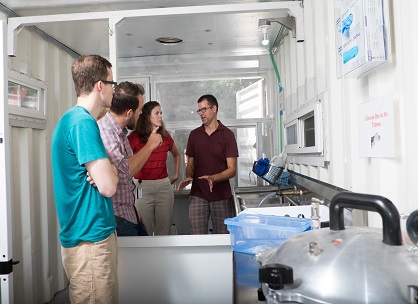
An associate professor of business and public policy at Rice’s Jones Graduate School of Business, Douglas Schuler and his team of business school students had one goal in mind: to develop a  complete, low-cost sterilization system to be used on surgical instruments in developing countries. Their research sought to elevate the sterilization standards in these regions and prevent unnecessary infections caused by contaminated instruments.
Originally beginning as a solar-powered autoclave, the team eventually created the Sterile Box, a steel shipping container fitted with a three-basin sink, autoclave, wire rack, and storage container. This solution was not only low-cost, but small enough that it could be deployed in remote areas or during post-disaster relief operations.
We were contacted by Professor Schuler as they began to test their newly designed system. He requested some of our common surgical instruments, and although we knew full well that he would make a mess of them, we had faith that his system would make them operating room ready. And our faith was not misplaced, with nearly every instrument testing back as completely sterile!
complete, low-cost sterilization system to be used on surgical instruments in developing countries. Their research sought to elevate the sterilization standards in these regions and prevent unnecessary infections caused by contaminated instruments.
Originally beginning as a solar-powered autoclave, the team eventually created the Sterile Box, a steel shipping container fitted with a three-basin sink, autoclave, wire rack, and storage container. This solution was not only low-cost, but small enough that it could be deployed in remote areas or during post-disaster relief operations.
We were contacted by Professor Schuler as they began to test their newly designed system. He requested some of our common surgical instruments, and although we knew full well that he would make a mess of them, we had faith that his system would make them operating room ready. And our faith was not misplaced, with nearly every instrument testing back as completely sterile!
 Although you may not see one at a hospital near you, the future of the Sterile Box looks bright! Professor Schuler and his team are currently seeking a location to begin tests in a clinical setting, with our hopes that their design improves healthcare quality in the places that need it most.
Congratulations to Professor Schuler and his team for accomplishing this engineering feat and for their dedication to improving healthcare in low-resource countries! Novo Surgical is proud to be a partner in this effort and to support research leading to improved healthcare quality across the globe. To read the full research article, published online in PLOS One, click here.
Although you may not see one at a hospital near you, the future of the Sterile Box looks bright! Professor Schuler and his team are currently seeking a location to begin tests in a clinical setting, with our hopes that their design improves healthcare quality in the places that need it most.
Congratulations to Professor Schuler and his team for accomplishing this engineering feat and for their dedication to improving healthcare in low-resource countries! Novo Surgical is proud to be a partner in this effort and to support research leading to improved healthcare quality across the globe. To read the full research article, published online in PLOS One, click here.
complete, low-cost sterilization system to be used on surgical instruments in developing countries. Their research sought to elevate the sterilization standards in these regions and prevent unnecessary infections caused by contaminated instruments.
Originally beginning as a solar-powered autoclave, the team eventually created the Sterile Box, a steel shipping container fitted with a three-basin sink, autoclave, wire rack, and storage container. This solution was not only low-cost, but small enough that it could be deployed in remote areas or during post-disaster relief operations.
We were contacted by Professor Schuler as they began to test their newly designed system. He requested some of our common surgical instruments, and although we knew full well that he would make a mess of them, we had faith that his system would make them operating room ready. And our faith was not misplaced, with nearly every instrument testing back as completely sterile!
Although you may not see one at a hospital near you, the future of the Sterile Box looks bright! Professor Schuler and his team are currently seeking a location to begin tests in a clinical setting, with our hopes that their design improves healthcare quality in the places that need it most.
Congratulations to Professor Schuler and his team for accomplishing this engineering feat and for their dedication to improving healthcare in low-resource countries! Novo Surgical is proud to be a partner in this effort and to support research leading to improved healthcare quality across the globe. To read the full research article, published online in PLOS One, click here.March 23, 2016
14 view(s) 