
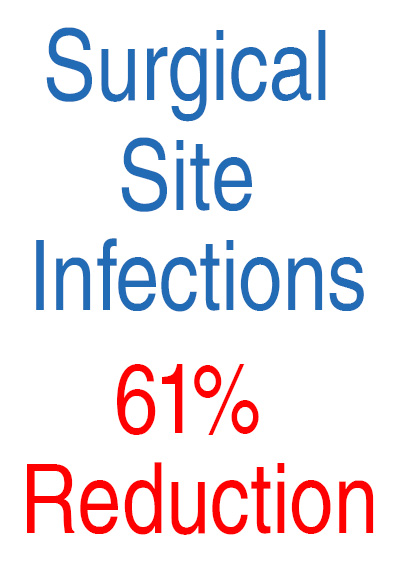
Surgical Site Infections Dropped 61% In Patients Following Colorectal Surgery
Surgical site infections (SSIs) dropped 61% over two years in patients undergoing colorectal operations in Hawaiian hospitals who were participating in the Agency for Healthcare Research and Quality (AHRQ) “Safety Program for Surgery.” These findings are documented in a new study published as an "article in press" on the website of the Journal of the American College of Surgeons.1
According to data from the CDC, SSIs cost $57,000 per occurrence to resolve and add 11 extra days of hospitalization. Additionally, an SSI increases the chance of the patient being placed in the ICU by 60% along with creating a significantly higher risk of being readmitted to the hospital after being discharged. Worst of all, patients who contract an SSI experience twice the mortality rate of surgical patients who don’t contract an SSI.2
Even after years of concerted effort by all stakeholders, SSIs remain a common, post-surgical complication. Recent data from the CDC documents the fact that SSIs account for about 20 percent of hospital-acquired infections.3
"It's a major problem because half of the patients in our hospitals have an operation, putting them at risk for infection afterwards," says study coauthor Julius Cuong Pham, MD, PhD, an associate professor at Johns Hopkins University School of Medicine, Baltimore, and a patient safety officer at The Queens Medical Center, Honolulu, Hawaii. "And a colorectal operation is a procedure with one of the highest rates of surgical site infection."4
To help address this issue, researchers from Johns Hopkins Medicine Armstrong Institute for Patient Safety and Quality, Baltimore; University of Hawaii, Honolulu; and University of California, San Francisco evaluated the effectiveness of AHRQ's “Safety Program for Surgery” in all hospitals throughout the state of Hawaii. The American College of Surgeons, in collaboration with the Johns Hopkins Medicine Armstrong Institute for Patient Safety and Quality, established the AHRQ “Safety Program for Improving Surgical Care and Recovery” (ISCR) in 2017.5
The primary goal of the study was to reduce colorectal SSIs and to improve the safety culture within the hospitals. Multiple clinical interventions were implemented; specifically chlorhexidine wash before procedures, proper use of appropriate antibiotics, and standardized post-surgical debriefing. Non-technical skills for improving the safety culture involved better communication, teamwork, and decision-making strategies.6
Two years after the start of the project, researchers found that the colorectal SSI rate for the collaborative decreased from 12.08 percent to 4.63 percent. The 61.7 percent reduction in colorectal SSIs seen is the greatest state-level reduction reported, the study authors noted.
"With this collaborative, we created a platform that allowed diverse types of hospitals to come together and accelerate learning and change," says lead study author Della M. Lin, MD, MS, an anesthesiologist in the department of surgery, University of Hawaii. "By not working in silos, we were able to accelerate the reduction in surgical site infections faster and perhaps more effectively than hospitals could do by themselves."7
Over the course of the study, the safety culture within the hospitals improved in 10 of 12 categories, as measured by the AHRQ Hospital Survey on Patient Safety Culture. Significant areas of safety improvement included teamwork across units, communication-openness, and overall perception of patient safety.
According to Pham, this level of improvement is very significant because changes in safety culture, especially using AHRQ's survey tool, are not common, and especially in the perioperative area. This study also demonstrates the fact that this program can be scaled up to a state level and likely to a health system level, according to Pham. "We already know that one or two hospitals can succeed at changing their safety culture. But it has never been done on a state level before."8
Equally important is the fact that the results are durable. "Since the Hawaii collaborative has ended, the infection rates are continuing to stay at these low rates, so that gives us some satisfaction knowing that there is sustainability in these remarkable results," Lin says.
"Instead of working in isolation, we are creating a space for all hospitals within the state to leverage not just the national work but also each other for more powerful results," Lin says. "This study is unique because it demonstrates how teams actually can get better ideas and results by synthesizing and harvesting the work together.”9
"Collaboratives are a great opportunity for shared experiences and learning, and have been repeatedly shown to be effective in improving care and outcomes in the surgical realm," says Clifford Y. Ko, MD, MHS, FACS, who is not a study author, but serves as the Director of Research and Optimal Patient Care at the American College of Surgeons. "In point of fact, the American College of Surgeons recently released the Optimal Resources for Surgical Quality and Safety, also known as the 'Redbook,' in which an entire chapter is devoted to the lessons learned from some of the leading collaboratives in surgery. The work done amongst these Hawaiian hospitals is another shining example of a successful collaborative."10
Reducing your patients’ risk of contracting a dangerous, painful and costly SSI is, and always will be, your number one goal. What makes this study so important is that it documents a substantial reduction in SSIs through the successful collaboration of all of the departments and their team members. Please share these great results with your staff and other department managers. This study proves that when it comes to reducing SSIs, everyone needs to be working together.
1. Journal of the American College of Surgeons website, Articles in Press, April, 2018
2. CDC Publication “Guideline for Prevention of Surgical Site Infection”
3. CDC website https://www.cdc.gov
4. Journal of the American College of Surgeons website, Op. Cite.
5. American College of Surgeons website https://www.facs.org
6. Journal of the American College of Surgeons website, Op. Cite.
7. Journal of the American College of Surgeons website, Op. Cite.
8. Journal of the American College of Surgeons website, Op. Cite.
9. Journal of the American College of Surgeons website, Op. Cite.
10. Journal of the American College of Surgeons website, Op. Cite.
June 14, 2018
14 view(s) 