
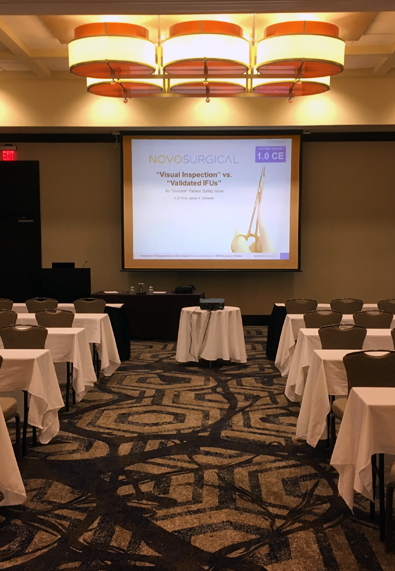
Novo Surgical’s Educational Program at the Ohio Association of Ambulatory Surgery Centers (OAASC) Annual Meeting
“Visual Inspection" vs. "Validated IFUs" An ‘Invisible’ Patient Safety Issue
Last month the Ohio Association of Ambulatory Surgery Centers (OAASC) held their Annual Meeting in Columbus, Ohio. As part of Novo Surgical’s ongoing commitment to better patient outcomes through improved technology and customer education, Novo sponsored a one-hour continuing education course for the OAASC attendees.
The 1.0 hour CE credit course was entitled “Visual Inspection" vs. "Validated IFUs" An ‘Invisible’ Patient Safety Issue. A large number of OAASC attendees took advantage of this informative and timely course.
When it comes to reprocessing reusable medical devices and instruments, the most misused and misunderstood word in our industry right now is validated. This is especially true when it comes to reprocessing instructions for use (IFUs). This one-hour course was designed to clarify the important patient safety issues associated with device pre-cleaning, decontamination, cleaning, sterilization and the critical role validated IFUs play in accomplishing these tasks.
The majority of reusable instrument manufacturers state that their reprocessing IFUs have been validated. However, when you read their IFUs, all that is actually stated is that the instruments were sterilized at a given temperature, time and pressure. In most cases, the cleaning instructions themselves have not been validated to prove whether or not the instruments were free of bioburden and, more importantly, biofilm prior to sterilization.
If a reusable medical device manufacturer wants to ‘validate’ their device’s IFUs, then they must follow the FDA’s validation requirements. These are:
- A sample of 3 or more instruments to be contaminated along with an additional instrument to serve as the control.
- The instruments must be thoroughly contaminated with a test soil prior to starting the cleaning process.
- After contamination, the cleaning steps that are listed in the manufacturer’s published IFUs must be followed to their conclusion.
- After completing the cleaning steps listed in the manufacturer’s published IFUs, the sample instruments must then be tested for residual bioburden and biofilm.
- The percent reduction in bioburden and biofilm after cleaning must then be calculated and published in the “Validation Test Results” table of the validation report.1
November 1, 2018
8 view(s) 