
FDA List of “Greater Risk” Medical Devices and Validated IFUs: Part IV
In Part I of this blog (1/26/18) we discussed the fact that the FDA has identified a subset of medical devices that pose a greater likelihood of microbial transmission after reprocessing and represent a high risk of infection (subclinical or clinical) if they are not, or simply cannot be, adequately decontaminated, cleaned and sterilized.1
According to data from the Centers for Disease Control and Prevention (CDC), over 30,000 patients die annually from surgical infections. A significant number of those surgical infections are caused by instruments whose reprocessing instructions (IFUs) have never been validated to ensure the removal of bioburden and biofilm. This is why so many contaminated instruments continue to be returned to the OR after reprocessing and causing patient harm/death.
According to an FDA report from 2015, one of the design features which poses a greater risk to patient safety and thus requires validated reprocessing instructions is any instrument with:
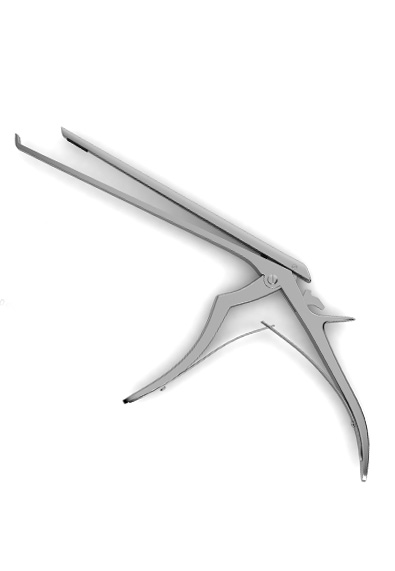
Interior device channels (e.g., the “I” beam and channel inside of a Kerrison Rongeur)2
The manufacturers of Kerrison Rongeurs have long-known that it is impossible to thoroughly decontaminate and clean the internal channel and “I” beam inside of a conventional Kerrison Rongeur instrument. Kerrison Rongeur manufacturers attempted to solve this decontamination and cleaning problem years ago by introducing ‘take-a-part’ or ‘modular’ Kerrison Rongeurs.
According to the manufacturers of take-a-part or modular Kerrison Rongeurs, their major benefit is that once they've been disassembled, you can supposedly 'visualize' the bioburden inside of the instrument and manually remove it. Regretfully, the human eye is NOT capable of seeing microscopic bacteria and biofilm on the surface of a surgical instrument.
Being able to 'visualize' the inside of a take-a-part Kerrison Rongeur does NOT ensure a clean, sterile, moisture-free instrument (assuming that reprocessing personnel know how or even remember to take the time to disassemble, thoroughly clean it and then properly reassemble the instrument). Regretfully, no manufacturer of take-a-part Kerrison Rongeurs has ever validated their cleaning IFUs. In point of fact, no manufacturer has ever even attempted to validate the cleaning IFUs on their take-a-part Kerrison Rongeur instrument because no two people can or will clean an instrument the same way on every reprocessing cycle.
 This is a disassembled, conventional Kerrison Rongeur that remained contaminated with bioburden after reprocessing. Note how the bioburden collects in the channel and around the interior “I” beam of the instrument.
So how does the FDA list of “Greater Risk” medical devices3 apply to you, to your healthcare facility and to your patients? Unless a surgical instrument manufacturer has validated that its cleaning process removes the bioload from the instrument, you have no assurance that you are sending a clean, sterile and safe instrument back to the OR. In light of this FDA report, and as recent lawsuits have shown, healthcare facilities have an ethical, moral, financial and legal responsibility to demand validated IFUs from all of their surgical instrument and reusable medical device suppliers.
1. FDA publication “Reprocessing Medical Devices in Health Care Settings: Validation Methods and Labeling” June 9, 2017 Appendix E
2. Op Cite
3. FDA publication “Reprocessing Medical Devices in Health Care Settings: Validation Methods and Labeling” June 9, 2017 Appendix E
This is a disassembled, conventional Kerrison Rongeur that remained contaminated with bioburden after reprocessing. Note how the bioburden collects in the channel and around the interior “I” beam of the instrument.
So how does the FDA list of “Greater Risk” medical devices3 apply to you, to your healthcare facility and to your patients? Unless a surgical instrument manufacturer has validated that its cleaning process removes the bioload from the instrument, you have no assurance that you are sending a clean, sterile and safe instrument back to the OR. In light of this FDA report, and as recent lawsuits have shown, healthcare facilities have an ethical, moral, financial and legal responsibility to demand validated IFUs from all of their surgical instrument and reusable medical device suppliers.
1. FDA publication “Reprocessing Medical Devices in Health Care Settings: Validation Methods and Labeling” June 9, 2017 Appendix E
2. Op Cite
3. FDA publication “Reprocessing Medical Devices in Health Care Settings: Validation Methods and Labeling” June 9, 2017 Appendix E
This is a disassembled, conventional Kerrison Rongeur that remained contaminated with bioburden after reprocessing. Note how the bioburden collects in the channel and around the interior “I” beam of the instrument.
So how does the FDA list of “Greater Risk” medical devices3 apply to you, to your healthcare facility and to your patients? Unless a surgical instrument manufacturer has validated that its cleaning process removes the bioload from the instrument, you have no assurance that you are sending a clean, sterile and safe instrument back to the OR. In light of this FDA report, and as recent lawsuits have shown, healthcare facilities have an ethical, moral, financial and legal responsibility to demand validated IFUs from all of their surgical instrument and reusable medical device suppliers.
1. FDA publication “Reprocessing Medical Devices in Health Care Settings: Validation Methods and Labeling” June 9, 2017 Appendix E
2. Op Cite
3. FDA publication “Reprocessing Medical Devices in Health Care Settings: Validation Methods and Labeling” June 9, 2017 Appendix EFebruary 15, 2018
11 view(s) 